Original text here from Patrice Bernard (LinkedIn)
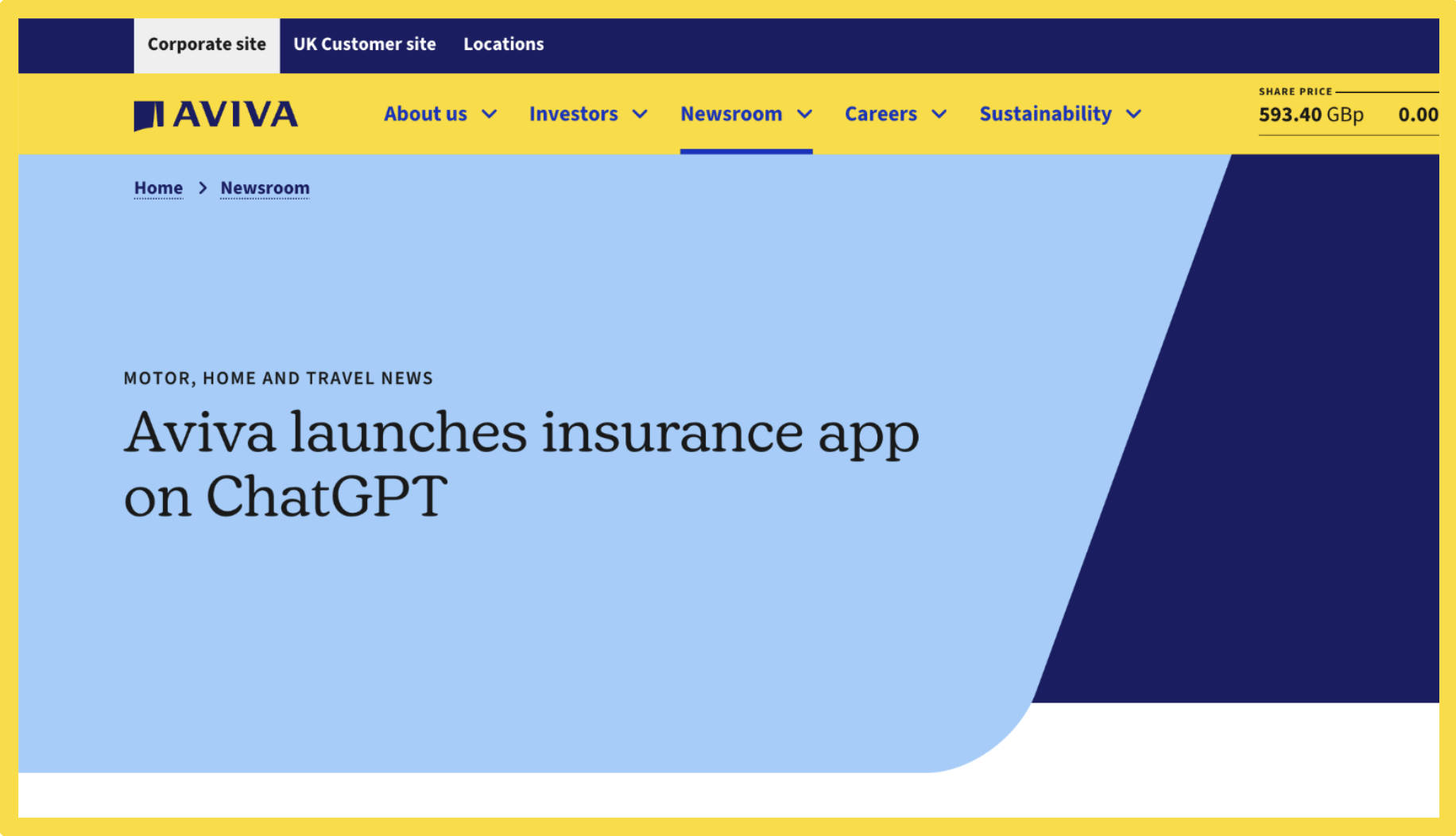
Since the launch of OpenAI’s marketplace for third-party applications within ChatGPT, financial institutions have been racing to establish an early presence. Unsurprisingly, after Experian (with an insurance comparison tool) and BBVA (with banking information), an insurer has now joined the movement: Aviva.
As with its predecessors, expectations should remain modest. The solution—expected to go live within a few weeks—simply adapts a familiar use case: generating home insurance quotes through a conversational interface. Behind the scenes, the heavy lifting is handled by Aviva’s existing online platform, “Signature,” which processes the full business workflow.
In practice, users are prompted to provide the key information required to define their needs: name, address (from which property data is automatically derived), contact details, and desired coverage options (such as whether to include contents insurance). In less than five minutes, the chatbot delivers a complete quote. If the user wishes to proceed, a link redirects them to the insurer’s website to finalize the purchase.
Subscribe to our newsletter:
At this stage, the value proposition appears rather limited. The experience offers little advantage over a traditional web journey, both in terms of efficiency and interaction depth. Moreover, it requires users to install or access the app within ChatGPT—an extra step that introduces friction for what is likely to be an occasional, one-off use.
However, Aviva’s positioning is arguably more pragmatic than that of some peers. The company openly frames the initiative as an experiment—a way to explore this new distribution channel and observe user behavior before expanding to additional products. This exploratory mindset is consistent with its past efforts, such as early experiments with voice assistants like Alexa.
Ultimately, the move says less about immediate innovation and more about strategic positioning. As ChatGPT and similar platforms emerge as new customer interfaces, insurers—like banks before them—are testing the waters, trying to understand what will truly resonate with users. The real challenge will come after this initial wave of experimentation: identifying use cases that deliver tangible value, beyond simple replication of existing services.